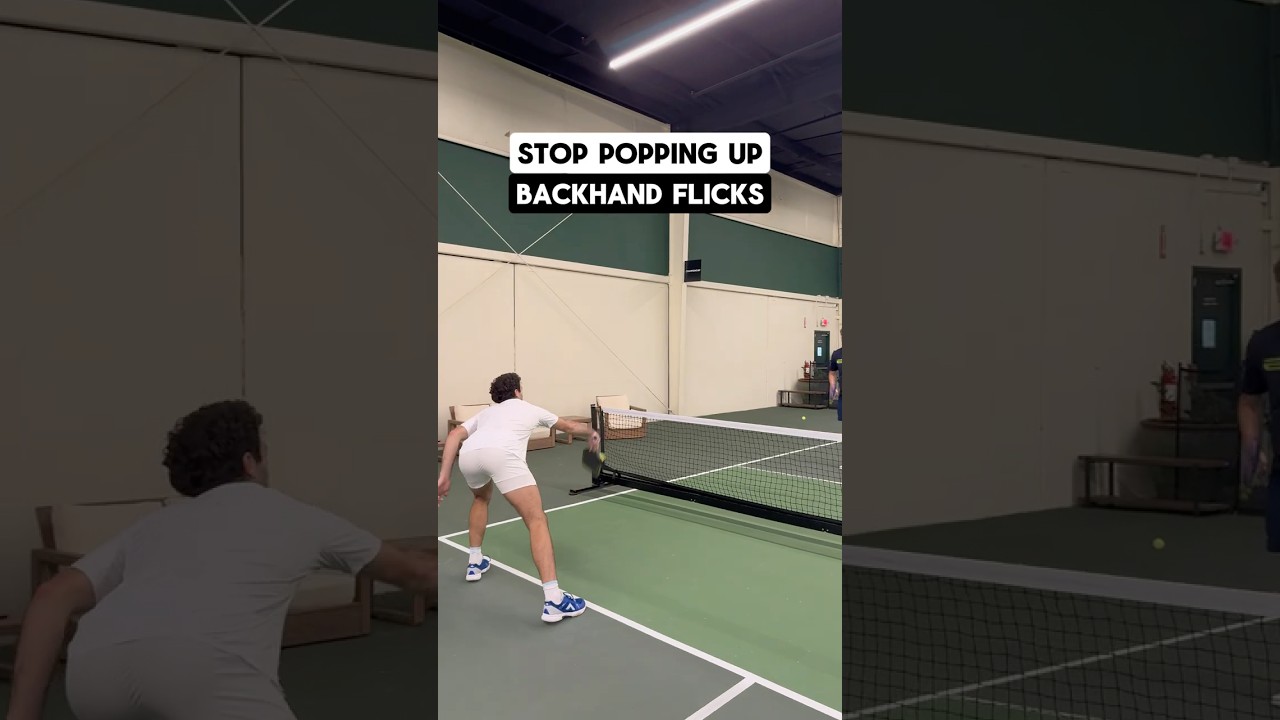
If your backhand flick consistently finds the net or sails long, the culprit is likely an open paddle face caused by a misguided attempt to create a safety margin. According to insights from Richard Livornese, the key to a reliable flick is maintaining a flat or slightly closed wrist position to leverage your paddle's grit for essential topspin.
Five Fixes for a Consistent Backhand Flick
To transform your backhand flick into a reliable weapon at the kitchen line, focus on these five mechanical adjustments:
- Maintain a compact ready position: Keep your elbow bent and your paddle positioned in front of your body. Avoid a large backswing, which slows your reaction time and telegraphs your intentions to your opponent.
- Check your wrist before swinging: Ensure your paddle face is flat or tipped slightly downward toward the court before you initiate your stroke. If the face is open and pointing toward the sky, you must correct it before contact, as you cannot fix the angle once the swing has begun.
- Drive with the elbow: Generate power by extending your elbow forward rather than relying on shoulder rotation. Visualize the motion as a short, snapping punch.
- Snap the wrist through contact: The flick motion is finalized by accelerating your wrist through the ball. This snap is the primary generator of the topspin required to keep your shot within the court boundaries.
- Accelerate through the ball: Never decelerate as you approach contact, as this is the primary cause of net errors. By maintaining swing speed with a closed paddle face, you create more spin, which provides a greater margin of safety over the net.
The common mistake recreational players make is opening the paddle face to "help" the ball clear the net. In reality, this creates an unpredictable trajectory that either sails long or forces the player to slow their swing, causing the ball to dump into the net. By keeping the wrist flat or slightly closed, you allow the paddle's surface grit to grab the ball and create a downward arc via topspin. This shift in technique allows you to swing with confidence, as the spin—not a cautious, slow swing—is what ultimately keeps your aggressive shot in play.