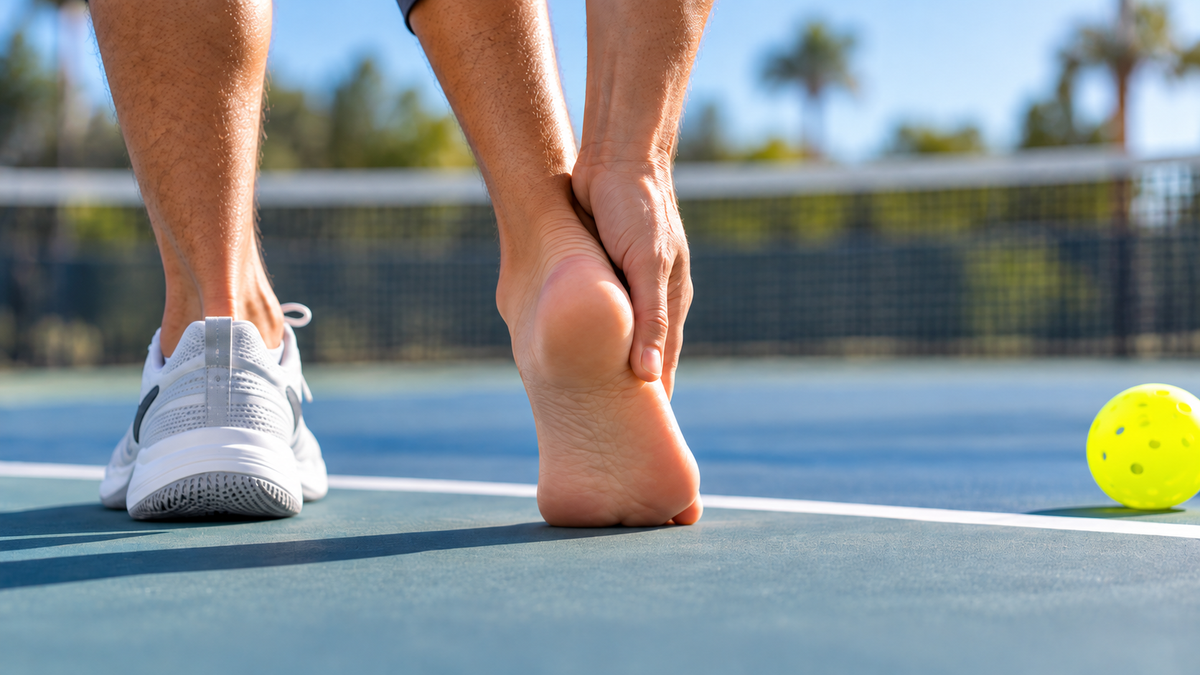
If you are struggling with recurring heel pain on the pickleball court, you are likely dealing with plantar fasciopathy rather than simple inflammation. While many players turn to rest, ice, and new footwear, these methods often fail because they do not address the root cause: the tissue on the bottom of your foot has lost the capacity to handle the high-intensity demands of the sport. To get back to the court pain-free, you need a progressive, 12-week strength protocol designed to rebuild your foot’s structural integrity.
Why Your Feet Are Failing
The plantar fascia acts as a spring, stiffening the arch during push-offs and sprints. When this tissue degenerates, it is usually due to one of five specific factors common among pickleball players:
- Limited ankle dorsiflexion: This is the most significant risk factor. When your calf is stiff and your ankle lacks range of motion, your body compensates by collapsing through the arch with every step.
- Volume spikes: Many players rapidly increase their court time—often moving from near-zero to 15 hours a week—without giving their connective tissue the months required to adapt.
- Insufficient calf capacity: Pickleball requires constant deceleration on the balls of your feet. If your calves lack the strength to handle this, the load is transferred directly into the fascia.
- Excessive time on feet: Standing occupations or long days on hard surfaces stack additional stress on top of your court volume, often exceeding your tissue's recovery threshold.
- The "Windlass" failure: Because the fascia functions as a lever during movement, failing to account for this mechanical process during training leaves the foot vulnerable to injury during split steps and shuffles.
The 12-Week Strength Protocol
Research indicates that strength exercises are significantly more effective than stretching for long-term recovery. This program should be performed every other day, with a specific morning routine done daily.
Daily Morning Routine (Before your first steps):
- Toe Pulls: While sitting in bed, pull your toes toward your shin with your hand. Hold for 30 seconds for three rounds.
- Arch Massage: Use your thumbs or a ball to massage the arch for one minute to manage morning stiffness.
Phase 1 (Weeks 1–3): Entry Load
- Heel Raises with Towel: Stand on flat ground with a rolled towel under your toes to keep them bent upward. Rise for three seconds, hold for two, and lower for three. Perform 3 sets of 12. The towel is essential for engaging the windlass mechanism.
- Knee-to-Wall Dorsiflexion: Daily, perform 2 sets of 15 slow reps per side. Drive your knee toward the wall without letting your heel lift. Do not bounce.
- Short Foot: While sitting, keep your foot flat and lift your arch without curling your toes or lifting your heel. Hold for five seconds. Perform 3 sets of 10 per side.