So you've watched a few games, maybe borrowed a paddle at a company outing or a friend's backyard, and now you're hooked. Welcome to the club. A very large, very loud, very enthusiastic club.
Pickleball is the fastest-growing sport in the country, and that's not just marketing talk. Participation has grown over 200% since 2020, and it's not slowing down. But with all the buzz comes a flood of questions, especially if you're just getting started or trying to figure out what gear you actually need. We pulled together the questions new players search for most and gave you real answers.
"Okay but… what even IS pickleball?"
It's a paddle sport played on a court about a quarter the size of a tennis court. You use a solid paddle (not strung like tennis or racquetball) and a lightweight perforated ball, kind of like a wiffle ball's sportier cousin. Games go to 11 and you have to win by 2. You can play singles or doubles, though doubles is by far the more common format.
The kitchen (officially called the non-volley zone) is the 7-foot area on either side of the net where you can't hit the ball out of the air. That zone is basically what makes pickleball, pickleball. It keeps the power game in check and forces players to be strategic. New players either love it immediately or find it completely confusing until it clicks, which usually takes about one session.
Serving is the other thing that trips people up. You serve underhand, diagonally, and the ball has to clear the kitchen and land in the opposite service box. Then both sides have to let the ball bounce once before they can start volleying. That's the two-bounce rule, and once you understand it, the whole game starts to make sense.
"How do I keep score? Everyone seems to call out three numbers."
Yes, it sounds weird at first. Here's how it works:
The server's score is called first, then the receiver's score, and in doubles, the server number (either 1 or 2). So "4-2-1" means the serving team has 4 points, the receiving team has 2, and the first server on the serving team is currently serving.
In doubles, each team gets two serves per turn (one per player) before the serve switches to the other side. The exception is the very first serve of the game. The starting team only gets one serve, which is why you'll sometimes hear "0-0-2" at the very beginning.
It takes a game or two before it feels natural, but it does click. And in casual rec play, most people won't be strict about it anyway.
"Is it hard to learn if I've never played tennis or ping pong?"
No, not really. It's one of the most beginner-friendly sports out there. Most people pick up the basics within the first 20 or 30 minutes of play.
You don't need a strong athletic background. Footwork matters more than raw power, and the smaller court means you're not chasing down every shot across a massive playing surface.
If you do have a tennis background, you'll actually have a bit of an adjustment period. The swing mechanics are different (shorter, more controlled), and trying to blast the ball the way you would with a tennis racket tends to send it sailing out of bounds. Tennis players sometimes take a little longer to unlearn those habits than true beginners do.
"What paddle should I start with?"
This is the most searched question for new players, and the answers online get way too technical, way too fast. Here's a simplified version:
Weight: Most beginners do best with a midweight paddle, somewhere between 7.5 and 8.5 oz. Heavy paddles can put strain on your elbow over time. Light paddles are forgiving on the arm but can be harder to control early on.
Core: Polymer cores are the most common and beginner-friendly. They absorb impact well, feel softer, and are generally quieter, which matters if you're playing at an indoor club or a neighborhood court with noise restrictions. Foam core paddles have also been getting a lot of attention lately and have become popular at all skill levels for their forgiving feel.
Face material: Fiberglass faces give you more pop, which is good for generating power without a big swing. Graphite faces offer better touch and control. Carbon fiber sits somewhere in the middle and handles spin well. For a first paddle, fiberglass or a basic carbon fiber face are both solid choices.
Shape: Standard (wide body) shapes are the most forgiving because the sweet spot is larger. Elongated paddles give you more reach but have a smaller sweet spot, which isn't ideal when you're still figuring out your contact point.
One thing worth saying directly: you do not need to spend $200 on your first paddle. There are great options in the $60 to $110 range that will get you through your first year of play without any real limitations. Buy expensive once you know exactly what you want and why.

"Does paddle weight really matter that much?"
More than most new players expect. If you've ever finished a two-hour session with a sore elbow or forearm, paddle weight is probably part of the equation. A heavier paddle transfers more shock to your arm on contact, especially when you're hitting a lot of reset shots or dinking at the kitchen line (and you will be doing that constantly once you get better).
The right weight range for most recreational players is somewhere between 7.8 and 8.3 oz. That gives you enough stability to control pace without putting unnecessary stress on your joints over time. If you have any existing elbow or wrist issues, go on the lighter side.
"What's the difference between an indoor and outdoor ball?"
Outdoor balls are heavier, have smaller holes, and are designed to handle wind and harder court surfaces. They feel firmer and move faster through the air. Indoor balls are lighter with larger holes. They travel a bit slower and feel softer off the paddle.
If you're playing outside, use an outdoor ball. If you're in a gym or indoor facility, use an indoor ball. Most regular players end up keeping both in their bag.
One more thing worth knowing: outdoor concrete courts chew through balls much faster than indoor gym floors. Keep a few extras on hand because they do crack, especially in colder weather.
"Do I need a USAPA-approved paddle to play?"
For casual recreational play (pickup games, open play at a club, playing with friends) no, you don't. Any paddle works fine.
If you plan to enter sanctioned tournaments through USA Pickleball, your paddle needs to be on the approved equipment list. This matters more than people realize because paddle technology has been changing fast, and some paddles have actually been pulled from the approved list due to surface texture or performance issues that fall outside current regulations.
If you ever plan to compete formally, just check the USA Pickleball equipment list before you buy. It's a quick search and it saves you from purchasing something that won't be tournament-legal.
"How long do pickleball paddles last?"
It depends on how often you play and what surface you're on. For a recreational player hitting two or three times a week, a quality paddle should last one to three years before the face starts to wear and you notice a drop in spin or feel. Competitive players who play daily often replace paddles every six to twelve months.
Signs it's time for a new one: the face feels noticeably slicker than it used to, you're losing spin even with clean technique, or you see any delamination (bubbling or separation between the face and core). A dead, hollow sound on contact is also a sign the core is breaking down.
"What about grip size? Does that matter?"
Yes, and it's one of the most overlooked things when buying a paddle. Too small a grip and you'll over-squeeze and tire your forearm out faster. Too large and you lose the wrist mobility that helps with spin and quick exchanges at the kitchen line.
A simple way to check: hold the paddle and try to slip one finger from your other hand between your fingertips and the base of your palm. If it fits snugly, you're in the right range. Most paddles fall between 4.0" and 4.5" in circumference. Smaller hands typically do better in the 4.0" to 4.125" range, larger hands in the 4.25" to 4.5" range.
When in doubt, go smaller. You can always add an overgrip to build it up, but you can't make a grip smaller.
"Is pickleball hard on your body?"
It's lower impact than tennis. Shorter court, smaller swing, less ground to cover. But it's not impact-free, and the sport has its own injury patterns. Pickleball elbow is essentially tennis elbow under a different name and it's the most common complaint. It usually comes from repetitive dinking or resetting shots with poor technique or a paddle that's too heavy.
Knee strain is the other one to watch, especially with the quick lateral movements at the kitchen line. Wearing proper court shoes (not running shoes) makes a real difference. Running shoes are built to absorb forward motion, not side-to-side movement. Court shoes give you the lateral support you actually need on the court.
And a real warm-up matters. Not two minutes of static stretching, but actual dynamic movement to get your legs and shoulders ready. Most common injuries in pickleball are preventable with a few minutes of prep before you step on the court.
"What are branded pickleball paddles and are they worth buying?"
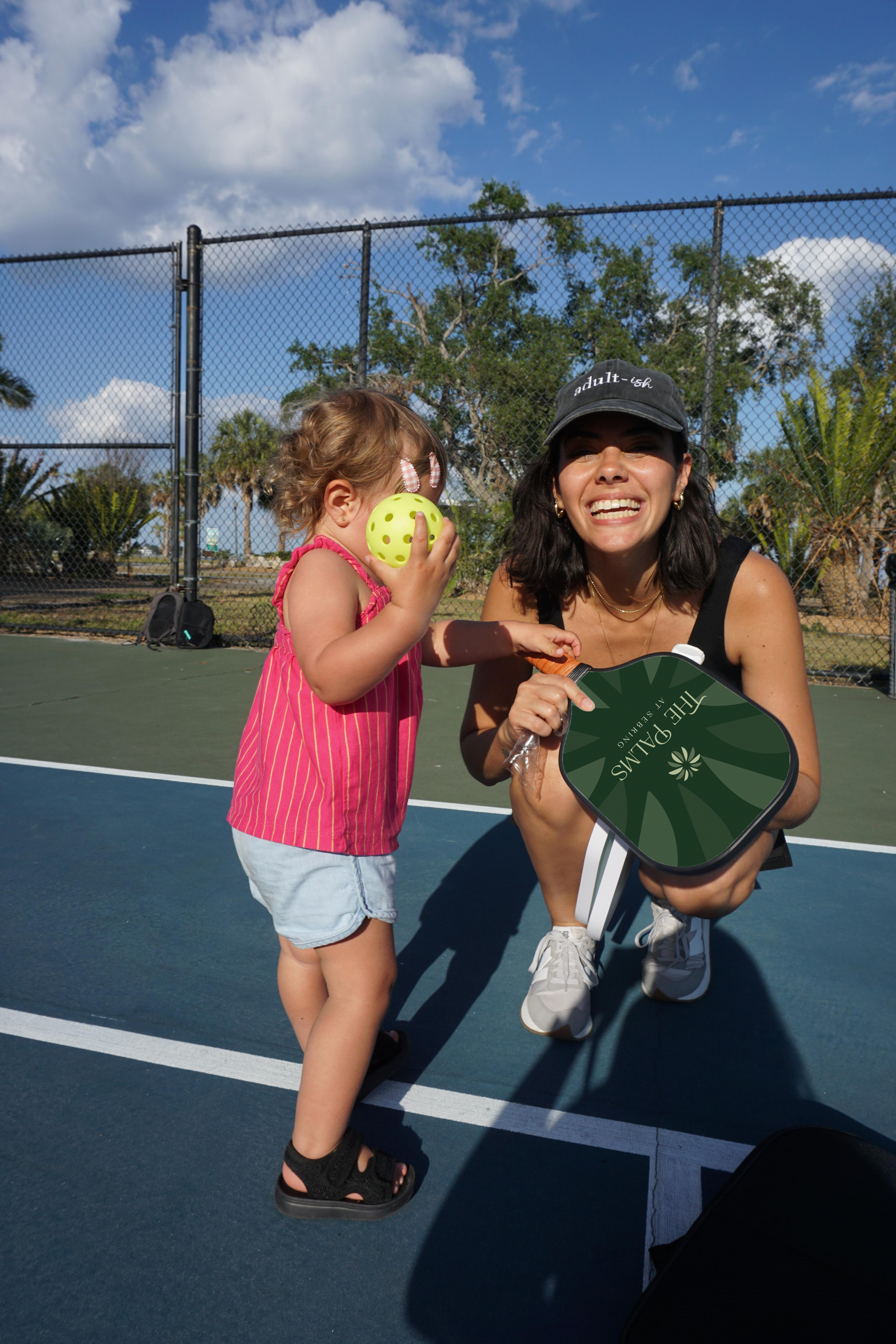
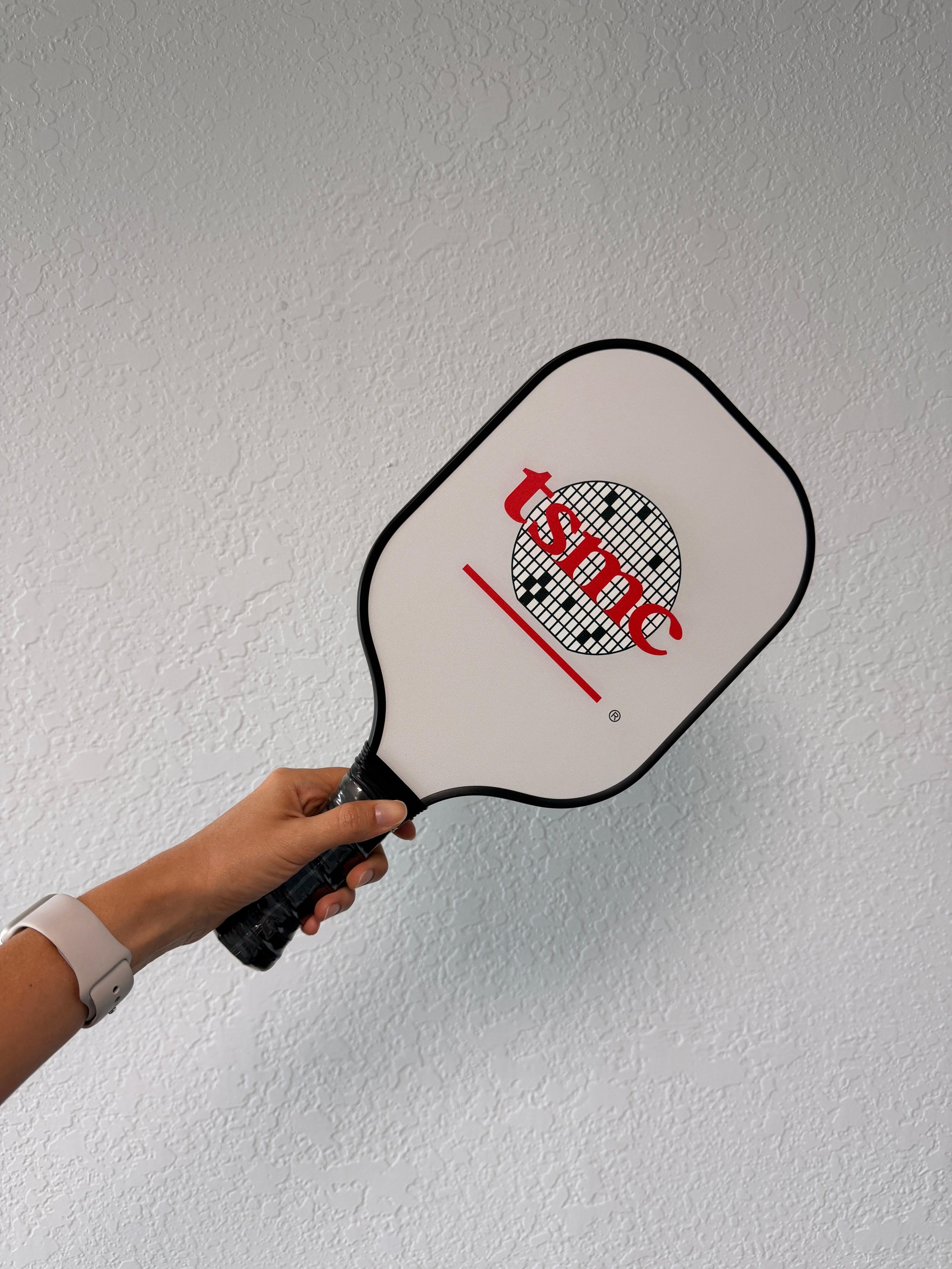
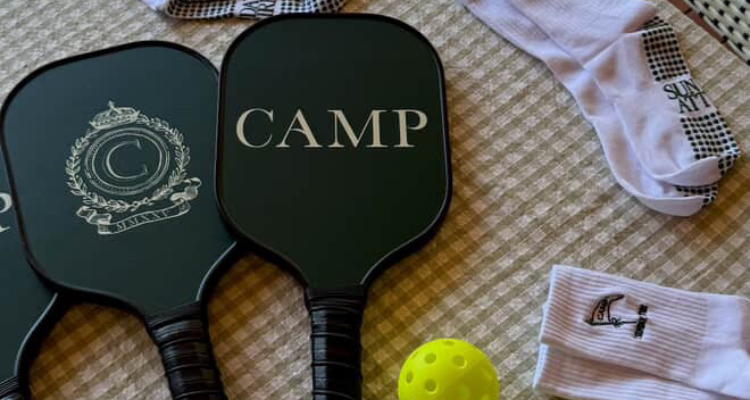
Branded pickleball paddles are paddles with custom artwork, logos, or designs printed directly on the face. Some people buy them purely for looks. Others buy them because they're picking up paddles for a group (a league, a company, a family trip) and want something that looks intentional rather than grabbed off a shelf.
The print quality varies a lot depending on how the paddle is made. Cheaper options use decals or heat transfers that wear off quickly. UV printing goes directly into the surface and holds up through actual play, which matters if you're buying paddles that are going to get real use and not just sit in a bag.
From a performance standpoint, a well-made branded paddle plays the same as an unbranded one with the same specs. For fiberglass, the artwork doesn't affect the core, the face material, or the weight. So if you're buying branded paddles for a group event or as gifts, you're not giving people a gimmick. You're giving them a functional paddle that also happens to look good.
If you want to browse options, we carry branded pickleball paddles at Branded Pickleball across a few different price points and styles.
"I want a custom paddle for my team or company. Is that actually a thing?"
It is, and it's more popular than most people expect. Company logo paddles have become a go-to for employee welcome kits, tournament sponsorships, and team-building events. Since pickleball keeps showing up at corporate outings and company events, having branded paddles on hand makes the whole thing feel planned rather than thrown together at the last minute.
At Branded Pickleball, we print custom paddles in-house using UV printing technology out of St. Petersburg, FL. Turnaround is 3 to 5 business days, minimums start at 10 paddles, and the print quality holds up over actual use (not just for display).
Check out our custom paddle page if you want to see what's possible, or reach out directly and we'll walk you through it.
One More Thing: Where to Actually Play
This trips people up too. The easiest way to find local courts is through the USA Pickleball Places2Play database or your local parks and recreation department. Dedicated pickleball facilities have been popping up all over the country in the last two years. Indoor clubs with dedicated lighting, permanent nets, and regular open play sessions are more common now than they were even 18 months ago.
Most places offer open play, where you show up, get in the rotation, and play against whoever's there. It's a great way to improve quickly because you end up playing against a wide range of skill levels. Find a local group, show up twice a week, and you'll be surprised how fast it comes together.
Questions? Reach out at brandedpickleball.com/contact or browse our shop for custom branded paddles, bags, and more.