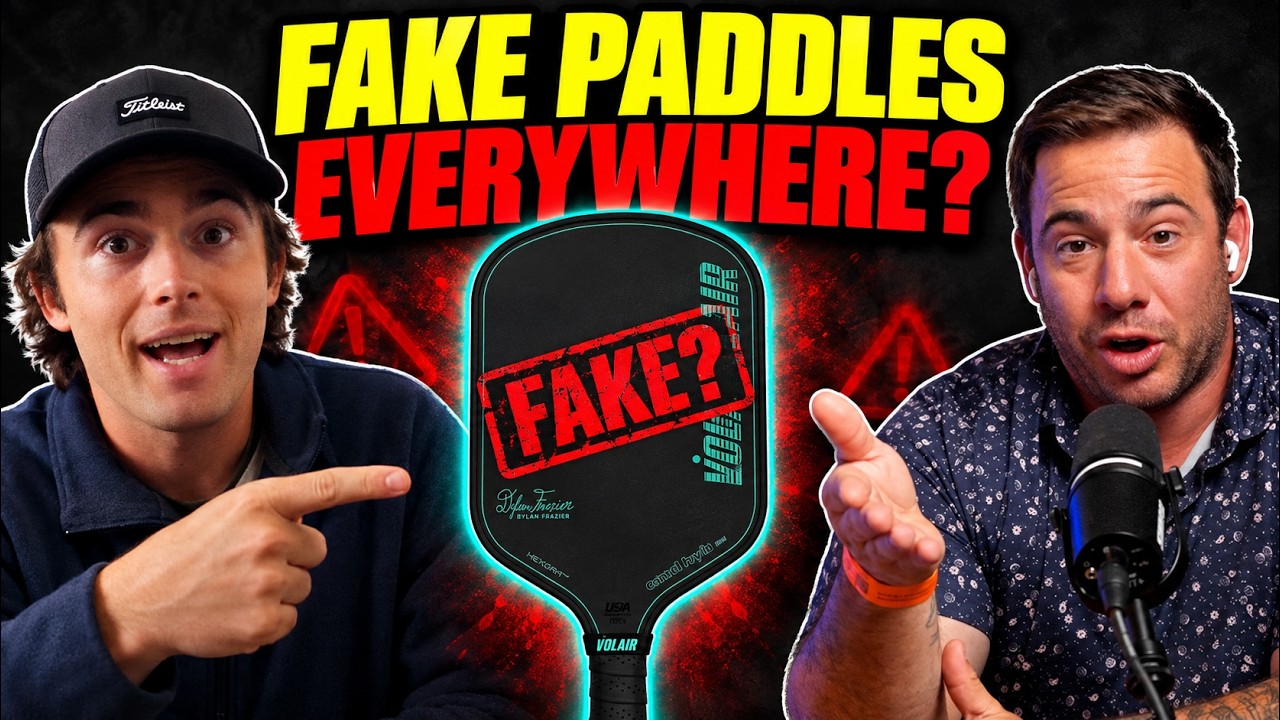
The pickleball industry is currently grappling with a sophisticated counterfeit market where fake paddles are often produced in the same high-end factories as legitimate, name-brand equipment. Former pro player and RPM Pickleball founder James Ignatowich recently shed light on this issue, revealing that the barrier to entry for paddle brands is low enough that counterfeit operations can easily exploit the global manufacturing supply chain.
Understanding the Factory Discrepancies
Ignatowich notes that there are only about six to eight factories worldwide that produce high-quality pickleball paddles, with only a handful considered truly excellent. When factories prioritize cutting costs over quality, the performance and durability of the paddle suffer significantly. According to Ignatowich, these are the primary areas where lower-tier factories fail compared to top-tier manufacturers:
- Handle consistency: High-end factories ensure every handle has a uniform shape and structural integrity, whereas cheaper facilities produce inconsistent grips that degrade quickly.
- Edge guard adhesion: While premium factories have perfected the application of edge guards, inferior manufacturers often use adhesives that begin to peel after only moderate use.
- Foam disbonding: For full-foam core paddles, the internal bonding process is critical; lower-tier factories often fail to prevent internal separation, which compromises the paddle's core.
- Surface grit consistency: Because grit is the primary driver of spin, variations in manufacturing can lead to paddles that perform nothing like the intended design.
- Quality control repeatability: Top-tier factories ensure every paddle in a production run is identical, while lower-tier factories produce inconsistent batches, leading to a "lottery" experience for the consumer.
The issue is compounded by the fact that some legitimate brands unknowingly utilize middlemen who source production from these subpar facilities. Furthermore, the market is plagued by a "return scam" at major retailers, where individuals purchase a legitimate paddle, swap it for a counterfeit version, and return the fake to the store, leaving the next unsuspecting customer to purchase the imitation.
Ignatowich also highlighted a performance gap between retail paddles and those used by professionals. He noted that it is an open secret that some pros receive paddles with significantly more surface grit than the versions available to the general public. This disparity in grit—which Ignatowich credits as a game-changing innovation that allowed him to advance from a 5.0 player to a PPA pro—is a major reason why he launched his own brand, RPM Pickleball, to ensure players have access to the exact specifications he demands on the court.