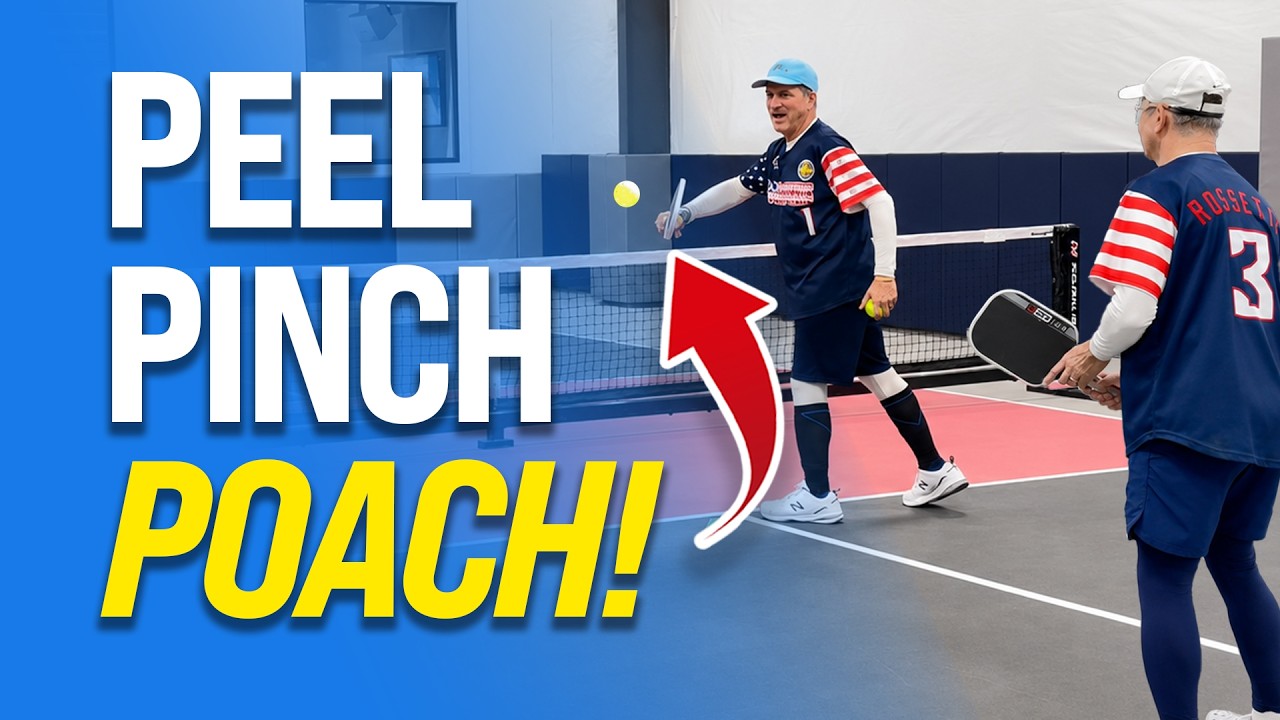
The staggered transition in pickleball, also known as the Peel, Pinch, Poach method, is a three-step system designed to improve doubles transitions by providing a clear sequence of movement and communication. This method, featured on DUPR Pickleball on YouTube with instructor Angela Rosetti, helps teams avoid common mistakes that occur when both players move to the kitchen at the same time, creating chaos and leaving gaps in the court.
When both players move to the kitchen simultaneously, neither one is fully committed to the ball in transition, making them both vulnerable. The Peel, Pinch, Poach system solves this problem by giving each player a defined role in the sequence, ensuring that one player is always stable while the other is moving. The three phases of the system are:
- Peel: The non-hitting partner peels toward the center when the ball goes up the middle, signaling to their partner that they are taking ownership of that side and allowing them to commit fully to the forehand in the middle. The peeling player moves halfway between the point of contact and the kitchen line.
- Pinch: After the hitting partner makes contact and begins their transition forward, the peeling player pinches toward the center line, creating coverage while the other player advances. This is a deliberate move along the center of the court, not a sideways drift.
- Poach: Once both players are in position near the kitchen, the player who pinched into the center lurks and looks to steal the ball, creating direct pressure on opponents. This sequence creates a natural, staggered flow where one player is always stable while the other is moving.
Implementing the Peel, Pinch, Poach System
The Peel, Pinch, Poach system is not just a physical movement, but also a communication tool. When the non-hitting partner peels toward the center, it signals to their partner that they have that side covered, and they can commit fully to the forehand in the middle. The pinch is a directional move toward the center line, following the spine of the court toward the non-volley zone. This creates visual pressure on opponents and forces them to pick a side. The poach comes from the lurk, where the player who pinched to center lingers in the middle and waits for an attackable ball, creating intentional pressure on opponents.
By using the Peel, Pinch, Poach system, doubles teams can improve their transitions, reduce mistakes, and create a more cohesive and effective playing style. As Angela Rosetti demonstrates on DUPR Pickleball, this system can be learned and implemented with practice, allowing teams to take their game to the next level.