New data released by DUPR provides a long-awaited, objective look at how pickleball skill levels are distributed across the global player base. By analyzing active users who recorded a doubles match in the 12 months leading up to September 2026, the report offers a reality check for players who often debate the true meaning of common rating benchmarks.
Understanding the DUPR Distribution
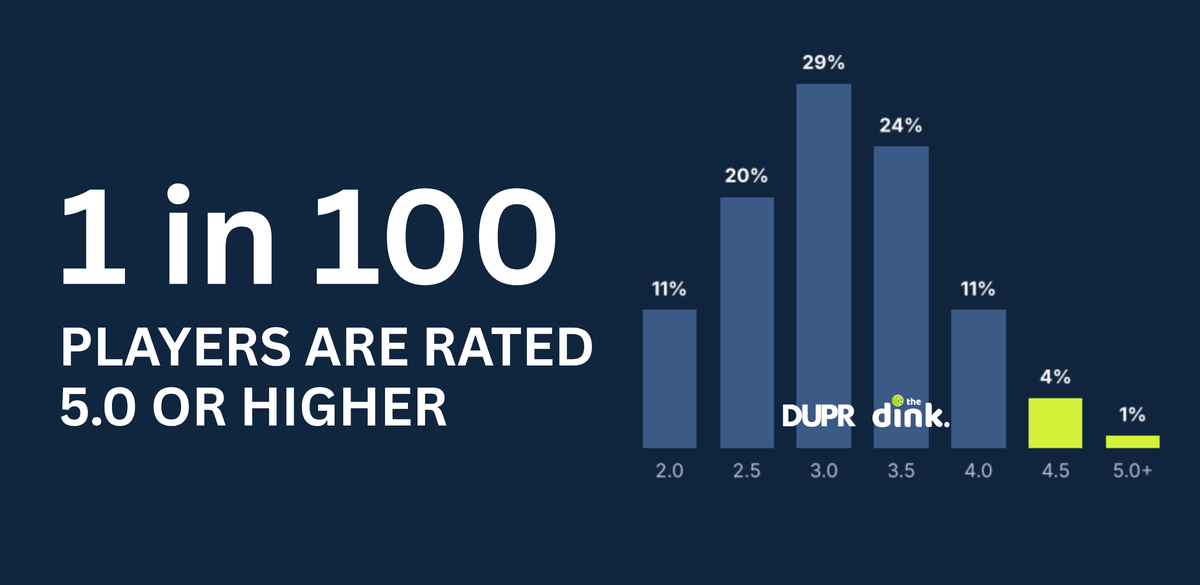
The data reveals that the vast majority of the pickleball population is concentrated in the mid-to-lower rating tiers, with the skill curve narrowing significantly as ratings climb toward the professional level. Here is the breakdown of the population distribution based on the latest DUPR findings:
- The 3.000–3.499 Range: This is the most common rating band in the sport, housing 29% of all rated doubles players.
- The 4.0 Threshold: Often cited as the barrier between recreational and "good" pickleball, a 4.0 rating actually places a player in the top 16% of the population. This means 84% of rated players have not yet reached this level.
- The 4.0–4.499 Range: This tier represents 11% of the total rated population.
- The 4.5–4.999 Range: Players in this bracket are quite elite, accounting for only 4% of the rated population.
- The 5.0+ Range: This exclusive group represents the top 1% of all rated doubles players. While these players may seem common in high-level tournament environments, they are statistically rare across the global DUPR user base.
The report also highlights that the median player falls within the 3.000 to 3.499 range. Because 31% of players are rated below 3.0 and 60% are below 3.5, the 50th-percentile player likely sits at approximately a 3.3 rating. Furthermore, 53% of all rated players fall somewhere within the 3.0 to 3.999 range.
It is important to note the limitations of this data to ensure it is interpreted correctly. This snapshot is specific to doubles ratings only and excludes singles data. Additionally, the dataset is limited to active, rated players who have logged a match within the last year, meaning it does not necessarily represent the skill level of every person who plays pickleball recreationally. Finally, because DUPR grouped all players rated 5.0 and above into a single category, the data cannot distinguish between the distribution of 5.5, 6.0, and professional-level players. Ultimately, this report serves as a useful benchmark for understanding where you stand relative to the active, competitive pickleball community.