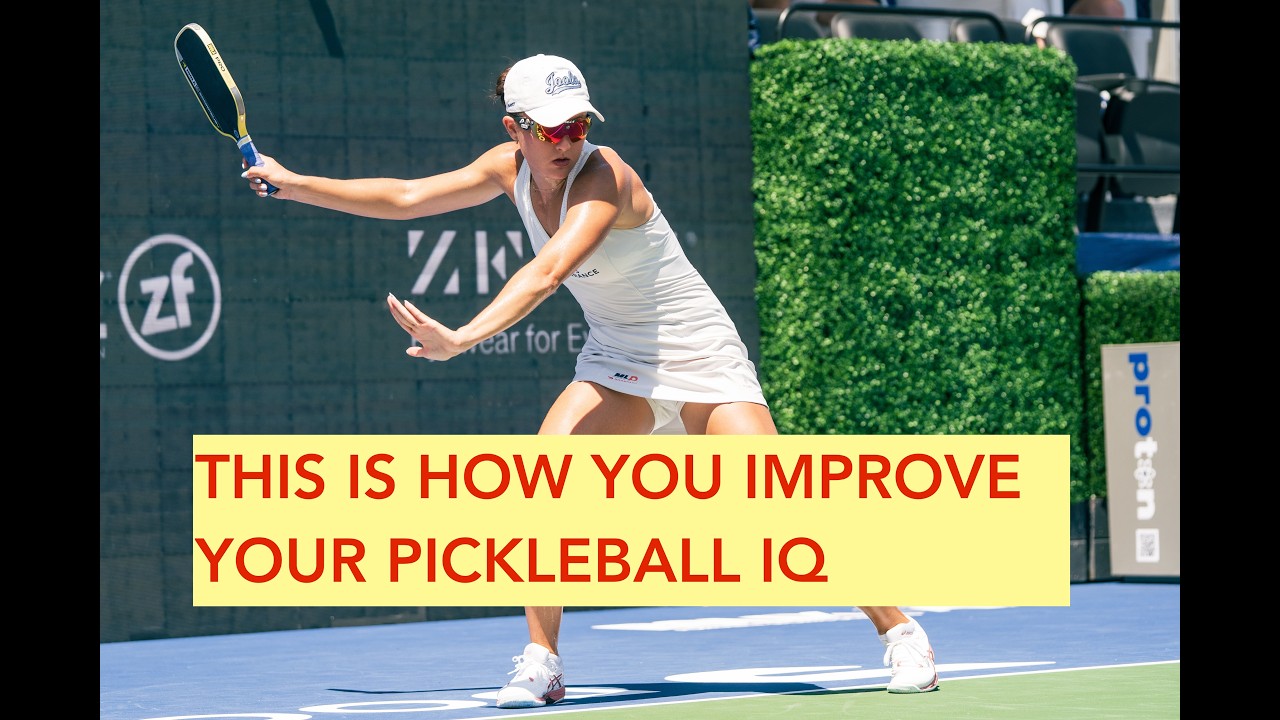
Pickleball IQ is the critical bridge between having sound technical skills and actually winning points against high-level competition. Professional player Anna Bright, the world’s number two ranked women's pro, recently broke down a high-stakes point from an MLP playoff match to demonstrate how Anticipation and Decision-Making (ADM)—a skill that can be trained through deliberate repetition—separates 3.5-level players from 5.0-level competitors.
Three Key Decisions in High-Level Play
By analyzing specific moments during a rally, Bright illustrates how pros process court geometry and opponent positioning in real-time to make the highest-percentage play.
- Handling a jammed ball: When a ball is hit directly into your body, your range of motion and angle options are severely restricted. Bright explains that you must immediately eliminate low-percentage shots like going up the line, pulling the ball wide crosscourt, or attempting a sharp angle dink. Instead, she recommends aiming for the middle; this keeps you balanced on your forehand side and ensures you remain in a strong position to handle the next shot, even if your opponent anticipates your move.
- Knowing when to avoid the speed-up: Many recreational players make the mistake of speeding up every "flickable" ball, regardless of the situation. Bright emphasizes that if the ball is low, your opponents are stationary and ready, and you already hold the advantage in the rally, the better choice is to reset with a crosscourt dink. The goal of a speed-up is to extend your advantage, not just to end the point; if the conditions don't support a high-percentage attack, patience is the superior strategy.
- Reading opponent positioning: When you have an opportunity to attack, you must analyze where your opponents are shifting. In the scenario Bright analyzed, her partner Kate had a high ball while their opponents were leaning toward the middle to cover the center. By recognizing that the opponents had committed to the middle, Kate was able to identify the sharp crosscourt angle behind the shifting player as the smartest option. This is described as "rock, paper, scissors at the highest level"—reading where your opponents are sitting and attacking the space they have vacated.
Bright notes that these decisions are not the result of luck, but of deliberate momentum management. By practicing ADM exercises—where you freeze a point and predict the best play before it happens—players can begin to close the gap between their technical ability and their tactical execution on the court.